Monday, August 13, 2018

Dynamic Orthotic


 Image result for DMO orthotic 


As a PT, we often help with teaching school faculty and staff how to use orthotics. An orthotic is an artificial brace or support for the limbs (arms/legs) or spine. In schools we typically see orthotics that are leg or foot braces. There is a newer orthotic that may appear in your classroom that we would love to teach you about! It’s called a DMO (dynamic movement orthotic) and looks like a special suit under the child’s clothing. This orthotic is used for postural stability, dynamic balance improvement, improved muscle tone and function. 

Fun fact! There are only 2 people in the state of VA certified to fit these orthotics!

Some common diagnoses that you may see use this orthotic: cerebral palsy, muscular dystrophy, Retts syndrome, Spina Bifida, Spinal Muscle Atrophy, Ehlers Danlos, Chromosomal Disorders, Downs Syndrome, and other developmental disorders.

Your School PT can help teach you how to use this orthotic and how to make basic adjustments if something happens during the school day. Please see the link below for what this DMO looks like!


Movement Matters~Whitney Carter PT, DPT 

Backpacks!

It's that time of year again! Back to school and we all know what that means.....shopping for school supplies is in full swing! One item that is frequently purchased is a new backpack. Backpacks come in all different types of colors and styles. 

Karen Jacobs wrote an article for : The Proceeding of the XVI Annual International Occupational Ergonomics and Safety Conference in 2002 titled: "Are Backpacks Making Our Children Beasts of Burden?" This article shares a lot of good research pointing to injury risks associated with backpack use. Please see the full article for details: https://www.researchgate.net/profile/Karen_Jacobs4/publication/228513365_Are_backpacks_making_our_children_beasts_of_burden/links/553d06560cf245bdd7698aa2/Are-backpacks-making-our-children-beasts-of-burden.pdf

Here are some helpful tips taken directly from the article:


Selecting a pack:
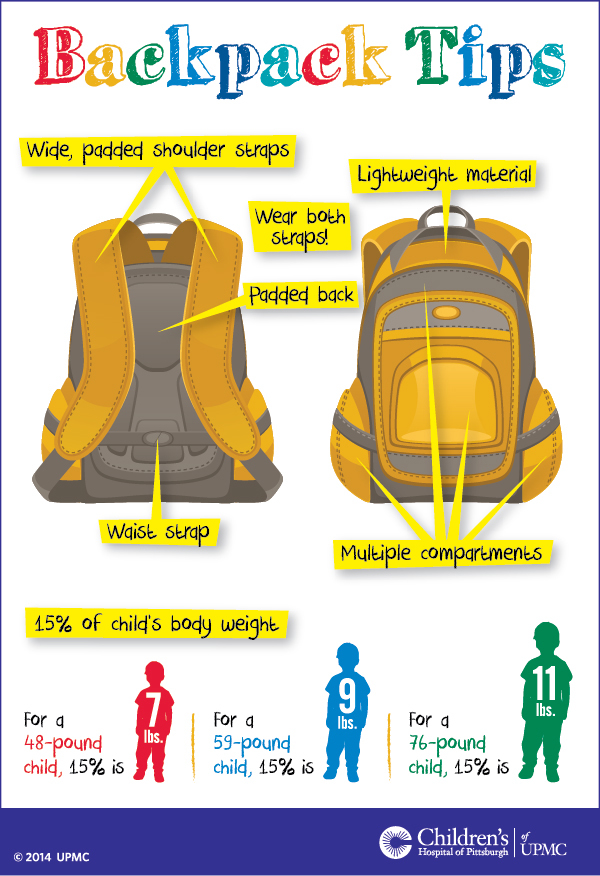
1.      Choose a pack that's appropriate to the child's size and age. School backpacks come in different sizes for different ages. 

2.      Select a pack with well-padded shoulder straps. The shoulders and neck are rich in blood vessels and nerves that when constricted can cause pain and tingling in the neck, arms, and hands. 

3.      Choose a pack with a waist belt to be fastened for extra support and to help transfer the weight from the shoulders to the body's trunk and hips. 

4.      Consider a pack with reflective trim to increase visibility of kids who carry the school backpack in the evening. 

5.      When shopping for a school backpack, take along books and other materials that the child would carry to judge how each pack varies when fully loaded.

Loading a pack:
1.      Never allow a child to carry more than 15% of his or her body weight. That means a child who weighs 100 pounds should not carry a school backpack that weighs more than 15 pounds. 

2.      Load heaviest items closest to the child's back. 

3.      Pack items neatly and organized to keep books and materials from sliding around in the pack, shifting the weight. 

4.      If a pack is too heavy, consider using one on wheels.

Wearing a pack:
1.      Always wear both shoulder straps to distribute weight evenly. Wearing a pack slung over one shoulder can cause a person to lean to one side and curve the spine. 

2.      Adjust the shoulder straps so that the pack fits snugly to the child's back. A pack that hangs loosely from the back can pull the child backwards and strain muscles between the shoulders. 

3.      The bottom of the pack should rest in the curve of the lower back. It should never rest more than four inches below the child's waistline. 

 Related image


https://www.google.com/search?q=backpack+safety&source=lnms&tbm=isch&sa=X&ved=0ahUKEwikxcfvz-rcAhUvrVkKHRxPAaYQ_AUICigB&biw=1047&bih=480#imgrc=6aVfZsgsVx0o8M:

L.L. Bean and the AOTA partnered together for a portion of the study! Check their websites for more details!

Let's keep our kids healthy and moving well this school year!

~Movement Matters! Whitney Carter PT, DPT

Wednesday, June 13, 2018

Summer Fun!


 Image result for last day of school


With Summer approaching, it's important to maintain the skills that your child has learned throughout the school year. Making fun games to play to progress their motor skills is easier than you think!

Here is a fun way to use sidewalk chalk to make a movement area that also asks a child to follow directions, practice reading skills, and motor plan!

https://www.pinterest.com/pin/196680708712368967/

Sidewalk chalk game for kids - could adapt for outside music lesson 


Please see below for a site that will allow you to print a calendar for movement activities for the entire summer! 


Get your summer activity planning calendars and have all of your summer activities planned for each weekday. These calendars focus on summer gross motor planning! 

It is so important to keep moving throughout the summer! You can make a "bucket list" of activities to complete! 
For example: 
1. Play on the playground  
2. Go for a walk in the woods
3. Make an indoor obstacle course
4. Pick an exercise of the day to complete together
5. Go to the pool

Whatever it is...keep it fun!

Just keep moving!

Movement Matters~ Whitney Carter PT, DPT
 

Wednesday, May 30, 2018

Mindfulness

Mindfulness

Image result for lotus flower 

Mindfulness is a practice that is a growing trend being utilized in schools today. By definition mindfulness means: a mental state achieved by focusing one's awareness on the present moment, while calmly acknowledging and accepting one's feelings, thoughts, and bodily sensations, used as a therapeutic technique.

Many school systems are using mindfulness training to help students prepare for the day, help students to identify stress and release that stress, and help students grow their ability to be more compassionate and resilient. 

In thinking about this practice, there are many ways to incorporate mindfulness into our sessions and classrooms. Helping our students to visualize their strengths and weaknesses through guided meditation can assist in making progress toward their therapy and classroom goals. 

For some of our students this can be a way for them to experience the world around them in ways that they may not have yet been able to achieve. We can help them experience movements, sights, sounds, smells, and many other items through this type of experience. The mind-body connection is fascinating and this is a great way to help our students be their best!

Below are some wonderful resources to explore:

This is a site with good ideas for teaching meditation and mindfulness to children: https://www.teachchildrenmeditation.com/category/special-needs/ 

This is a site that gives 10 steps for guided meditation in children: https://center4specialneeds.org/blogs/news/ten-steps-to-mindfulness-meditation

This is a site to share with parents of children with special needs to insure that they are taking care of themselves as well: https://www.huffingtonpost.com/eden-kozlowski/the-necessity-of-meditati_b_5984646.html

This is a link for TED Talks related to mindfulness: https://www.ted.com/topics/mindfulness 

~ Movement Matters!- Whitney Carter PT, DPT